






Washington Can’t Afford It
Every law has a cost. Families should come first.

Quick Facts:
- Cost of living above national average
- One of the most expensive states for housing
- Consistently among the nation’s top three highest gas prices, about a dollar above the national average.
The Three Pillars of Affordability

Economic Affordability – Keep Washington Livable
-
- Reject costly policies
- Reduce expenses
- Protect jobs
- Washington can’t afford higher taxes and fewer economic opportunities.

Community Affordability – Keep Washington Safe
-
- Prioritize victims’ rights
- Strengthen law enforcement
- Protect kids
- Washington can’t afford policies that put our communities in danger.

Future Affordability – Keep Washington’s Promise
-
- Improve schools
- Strengthen families
- Reinvest in kids
- Washington can’t afford to neglect its responsibility to our kids and to their future prosperity.
Are you broke yet?
You may be soon. Democrats are pushing a jobs tax, an income tax, and higher business taxes—stacked on top of this year’s hikes in gas, sales, and property taxes. Washington simply can’t afford it.
Legislative Democrats propose a JOBS Tax
Watch for yourself

MYTH VS FACT
MYTH: So much was cut from the budget last year that there isn’t anything left to cut.
FACT: The budget actually GREW by 8.2% last year. Democrats didn’t make cuts – they changed their funding priorities and programs such as one caring for drug-addicted babies were defunded.
MYTH: Last year’s deficit was $16 billion to $20 billion.
FACT: According to NONPARTISAN staff, the true deficit was $7.3 billion. Democrats made a policy choice to fund $4 billion in pay raises for state employees. They did NOT need to pass the largest tax increase in state history.
MYTH: We need more “revenue,” including an income tax.
FACT: The Democratic majority doesn’t have a revenue problem. It has a spending problem. Democrats need to reevaluate their priorities. Also, a graduated income tax, which taxes people at different rates based on their income, is unconstitutional in Washington and voters have rejected a state income tax 11 times. This hasn’t deterred Democrats from pushing for one and lobbying the state Supreme Court to consider it an excise tax instead.
dubious distinctions
- The fastest growing part of the budget is lawsuit settlements worth billions of taxpayer dollars paid to victims and their families for Democratic mismanagement of state agencies and their policies that result in the injury and death of the most vulnerable.
- Washington remains dead last nationwide for the number of law enforcement officers per capita, despite the hiring of more than 300 new officers.
- Washington is one of the three most expensive states for gas prices due to Democratic carbon taxes
- The average household income in Washington is roughly half what is required to qualify for the median-priced home.
- Washington’s restaurants have to charge the highest prices in the nation, but have the lowest profit margins in the nation (1.5% compared to the 4% national average).
- Washington is rated 35th nationwide for business climate, down from 15th in 2022. The drop is due to the income tax on capital gains.
- Washington ranks as the 7th least affordable state for infant care, with care for one infant costing 17.8% of a family’s yearly income.
- Democratic policies will force an 18.6% electric rate hike over the next two years for many Western Washington consumers.
- Washington could see blackouts across the state due to Democrats’ policies that will remove 1292 megawatts of electricity from the grid in 2026.
Why so much more?
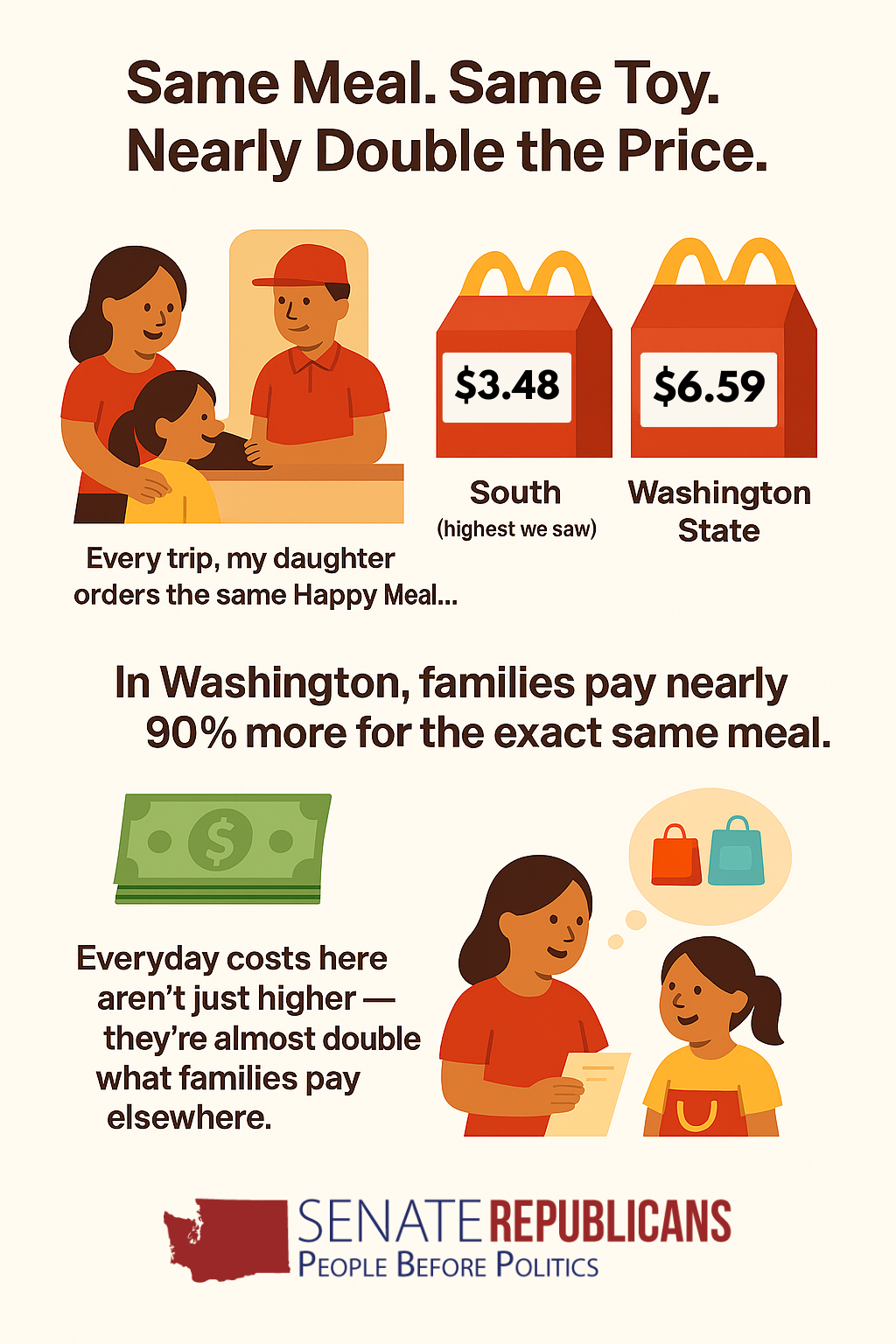
A parent shares how everyday costs in Washington far outpace what families pay elsewhere.
My daughter is 9, and when we travel across the country to visit family in Georgia, Alabama, Mississippi, or Tennessee, she always gets the same McDonald’s Happy Meal—cheeseburger, chocolate milk, fries, apple slices, and a toy. In Atlanta, it cost $3.27, and the most expensive we’ve seen on our trips was $3.48. At my home in Washington State, the exact same Happy Meal is $6.59—roughly 100% more for the same meal and portion size.
Before passing another law, we should ask one question: Can Washington afford it – not just in dollars, but in safety, trust and opportunity?
Families across Washington are struggling to pay bills, find affordable housing, and feel safe in their communities. Polls show “affordability” is the people’s top priority. Every decision in Olympia has a cost, and it’s time we make affordability the test for every policy – financial, moral and generational.
As the minority, our job is to hold the majority accountable for the cost of their leadership and to offer common-sense solutions Washington CAN afford.
Washington can’t afford policies that make life harder for the families we represent.
Video
On The Elephant in the Dome podcast, Sen. John Braun unpacks the affordability crisis in Washington—from groceries to housing to Medicaid. He explores priorities, long-term costs, and what lawmakers must do to keep essential services sustainable.
On [un]Divided, Sen. John Braun joins Brandi Kruse to discuss Washington’s housing crisis, tax hikes, and the state’s economic outlook, warning of business flight and urging fiscal restraint amid growing budget challenges.